Thursday, November 21, 2013

Blog 9: EQ

1. "I reviewed the rule of three for writing an EQ."

2.a.  What is the most important factor in healthy weight loss?

This EQ doesn't meet the rule of 3 criteria. When I first read this EQ I though it was great but after further investigation I realized that it could use some improvement. Although the question does allow someone to research this topic in depth, they could be more specific in the wording. I don't quite understand what they mean by healthy weight loss because the word healthy can be interpreted by different people in their own way. I would improve that EQ by changing the wording a little and being more specific. 

 2.b.  What is most important to securing a conviction in a criminal investigation?

This EQ doesn't meet the rule of 3 criteria. I feel like the main problem with this EQ is that it is too broad, and it doesn't necessarily focus on one specific topic. The author of this EQ could have been more specific on what type of conviction they wanted to focus on, such as a federal or state crime. If I were to improve this EQ I would just add some more details on the type of conviction or crime. 

2.c.  What is most important in creating a hairstyle that best satisfies a customer?

This EQ doesn't meet the rule of 3 criteria. I believe that the question is a little broad, but if the word choice is improved it could be great for finding in depth research.  It could be more specific on the type of haircut. If not the type of hair cut, maybe the question could focus on and era of hair cuts, an example being how modern hair cuts differ from hair cuts in the 1970s. Also, the author should pin point their ideal customer, are they trying to create a haircut that satisfies a young customer or and older one?

2.d.  How can an Anesthesiologist best treat chronic pain? 

This EQ may meet the rule of 3 criteria. I believe that this EQ would allow for in depth research and would let someone argue a point. Aside from that, if the author wanted to be more specific when writing their EQ they could have mentioned a certain type of treatment or a certain area in the body that pain is occurring. I would tell the author to just improve their format and be a little more specific. 

3. What is the best way for firefighters to limit injuries and fatalities when fighting structural fires? 

The biggest change that I did to my EQ was deciding what type of fire to focus one. I choose to focus my EQ on the aspect of structural fires, rather than wild land fires because I find them more interesting. 

Thursday, October 31, 2013

Additional Post Two: Mentorship

During the month of October I did many things at my service learning in fire station 166. One of the most memorable things that I have had the opportunity to do was help during El Monte's Children Day Parade with the rest of my fire explorer post. 
2013 Parade Line Up19th Anniversary Children’s Day Parade

My duty for the day was to put on a costume, in the blazing sun, and wave at the pedestrians during the parade. Although it was extremely tiring, the experience was well worth it because I got the be in the parade with the rest of my fellow explorers. Aside from that I later had to help clean up and put stuff away once the parade was over. 

This experience showed me that being an explorer doesn't only consist of meeting on the weekends and learning about something new, we also have to give back the the community and the people even if it means getting your hands a little dirty. 

The picture above is me prior to the parade. I only had a piece of the costume on. 

Wednesday, October 16, 2013

Blog 8: Research and Working EQ

Content:

1.  What is your working EQ?


What is the best way for firefighters to limit injuries and fatalities when fighting structure/wildland fires?

2.  What is a possible answer to your working EQ? Please write the answer in thesis format. 

  • If firefighters take time to perform a proper scene size up at every call then they will be aware of their surroundings and environment, thus helping then know possible exit routs . 
  • Firefighters should properly inspect their equipment and turn out gear daily in order to be properly suited for any incident or call that may arise in the near future. 
  • If firefighters properly communicate with their fellow brothers, meaning that each one talks to one another about their situation and if they feel the are is becoming unsafe, then there will be a lesser chance of getting and injury or death. 

3.  What is the most important source you have used that has helped you come up with an answer to your working EQ? 

My most important source that I have used that has helped me come up with an answer to my working EQ is probably my 13th source which is titled "Sizing Up For Structure Fires" because it allowed me to see the true importance that being aware of your surroundings on the job. 


4.  Who is your mentor, or where are you volunteering, and how does what you are doing relate to your working EQ?

My mentor is Firefighter Cunningham who is a firefighter for LA County Fire Department. He is also a fire explorer post leader who decides what we are doing most of the time. I am volunteering my time every weekend at fire station 166 in the city of El Monte. This is related to my working EQ because by learning about the career of firefighting I am also getting the opportunity to learn about how injury and death goes hand in hand with the career. 

Wednesday, October 2, 2013

Blog 7: Independent Component 1 Approval

1.  Describe in detail what you plan to do for your 30 hours.

For my 30 hours, I plan on continuing to mentor at my local fire station and doing any tasks they require me to do. I would be able to meet every weekend for approximately 4-5 hours. I'd be expanding my knowledge on the topic of firefighting mostly by becoming familiar with basic fire techniques which we usually learn there. These techniques range from topics such as hose lay evolution, ladder techniques, the proper us of fire fighting tools and equipment, and many other fire fighting skills. I'm eager to learn about anything fire related that my mentor, or post leader, has in store for the other explorers and I. The topics we are taught often overlap week after week, since many are skills that we have to master through hands on activities.  All these skills are basic techniques that, although may be simple to learn, are hard to perfect and master. I plan on doing any tasks that are required of me during my explorers program and also hopefully becoming an expert on as many of these subjects as I possibly can by completing these 30 hours. 

2.  Discuss how or what you will do to meet the expectation of showing 30 hours of evidence.

I plan on recording everything that I do for this independent component by accurately filling out my hours log. I will also ask my mentor to write me a letter that confirms my attendance. Aside from that I will also be keeping any handouts that we receive and making copies of them in order to store them aside for this specific component. Lastly, I plan on taking as many pictures as possible in order to completely justify my 30 hours of work. I feel that taking photographs is probably the best way of showing evidence because someone can't just create a fake picture and have it pass as evidence. 

3.  And explain how what you will be doing will help you explore your topic in more depth.

Continuing to attend my fire explorer meeting will allow me to explore my topic more in depth by helping establish me for future success. Every piece of information that we receive is used in one way or another and is eventually applied to the real world. I would also get to learn more about firefighting by simply being exposed to other firefighters and observing the way they work. Learning the basics of firefighting will eventually aid me in truly understanding the much more complex aspects of this job, which I plan on doing in the near future. 

4.  Post a log on the right hand side of your blog near your mentorship log and call it the independent component 1 log.

Done.

Monday, September 30, 2013

Additional Post One: S.C.B.A.

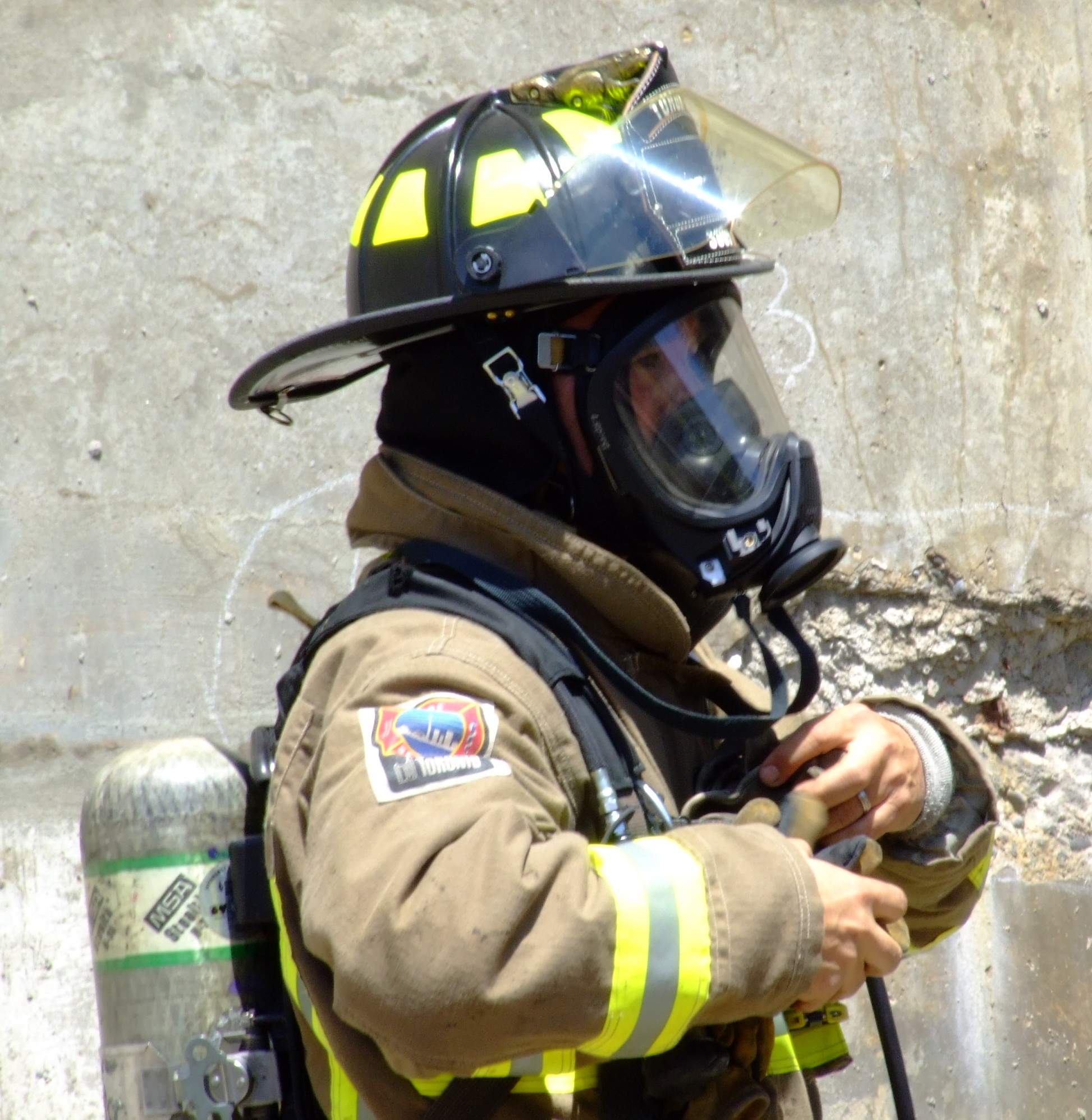
Since I have joined the fire explorers program this summer I have learned many new things. Our post tends to focus on a different topic of firefighting each month (sometimes week). For the month of September the other explorer and I focused the majority of our time learning about SCBAs (self-contained breathing apparatuses).

The image above shows a firefighter wearing a SCBA.

The purpose of a SCBA is to provide compressed air to firefighters in an IDLH (immediately danger to life or health) atmosphere. I have learned the 8 major components of a SCBA, how to properly care for and inspect a SCBA, and the 3 most common ways of donning a SCBA.

There are 8 major components that make up a SCBA. These components include:
The image above shows a SCBA.


    1. Air Cylinder
    2. Facepiece
    3. Voice Projection Unit
    4. Backpack Harness and Frame
    5. Integrated PASS Device
    6. Air Gauge/Alarm
    7. 1st Stage Regulator and hose
    8. 2nd Stage Regulator 

*Firefighters are expected to inspect their SCBAs daily at the start of each shift and after each use.
  • They also have to test their SCBA at least once a week to make sure that every component is properly functioning. 

Aside from learning the parts of a SCBA and when to care for it, we also had to learn how to don a SCBA. There are 3 proper methods of donning a SCBA.
  1. The first method is known as the Overhead Method.
    1. This method of donning the SCBA is called the overhead method because when you are initially putting the SCBA on you have to throw the bottle over your head in order for the backpack harness/frame to slide down your back. 

  1. The second method is known as the Sling Method.
    1. This method of donning the SCBA is called the sling method because when you are initially putting the SCBA on you have to grab a strap with one hand and sling it onto the opposite shoulder.

  1. The third method is known as the Crosshand Method.
    1. This method of donning the SCBA is called the crosshand method because when you are initially putting the SCBA your hands are cross over one another. 

*After learning the three methods of donning a SCBA we had to practice putting them on so that it takes no longer than 1 minute. 

Overall, an SCBA is an extremely useful piece of equipment that is used often by firefighters, which is why it is so important that firefighters know every part of it. 


Tuesday, September 17, 2013

Blog 6: Second Interview Questions

Content: 

1. Justin Cunningham / L.A. County Fire Department 

2. I plan on asking my mentor questions that will help me justify him as an expert in his topic. These questions include:

  • Can you tell me a little about yourself and your work experience?
    • How long have you been working on the job?
  • What can you tell me about about the L.A. County Fire Department?
    • Did you always want to work for L.A. County?
  • What are some jobs that you had prior to becoming a firefighter which helped you become one?
  • What are some programs or events that you choose to partake in  which helped you reach your career?
  •  When did you know that you wanted to become a firefighter? 
  • What did you have to do in order to become a firefighter? 
  • How did you physically and mentally prepare yourself for becoming a fireman?
  • In what way has this career effected your life?
  • What do you have to do, and what do you do, in order to be the best firefighter you can possibly be?
  • How would you plan on further expanding your knowledge related to this topic?

Sunday, September 8, 2013

Blog 5: Project Reflection and Working EQ

1. Positive Statement: What positive thing happen as a result of what you have completed so far?  

After completing my summer mentorship and findings an extensive amount of research I have been able to learn more than I would have ever imagined about the fire department. I have met many people who work and aspire to work for the fire department simply through completing my mentorship hours. That experience alone has also given me the opportunity to work hands on with other firefighters as they tough me vital information which they use on a daily basis, such as throwing ladders onto buildings and properly using their safety equipment. Although I would have to say that the majority of the positive things that have happened so far have come from completing my mentorship hours, I don't want to undermine the importance that finding research has had on me. Researching has allowed me to learn about several different aspects of firefighting, such as health, safety, and work life. All these positive outcomes that have arisen so far have had a big impact in my life, seeing as the new stuff that I have learned will help me forever.  

2. EQ Content: Pick a piece of research or your interview. How has it helped you improve your understanding of your topic?  

After reading "The Importance of Staying Hydrated" by Aaron Zamzom I was able to get a small glance at a minor hardships that firefighters are faced with, hydration. Although hydration plays a huge role in a firefighters life, many ignore its importance. It helps keep their bodies functioning properly and it protects them from several other heath conditions, such as heat cramps, heat exhaustion, and even heat strokes. At first I thought that this article was going to be of no use, and to be honest I only got it because it seemed amusing, but after reading it I knew that I was wrong. This article was filled with several facts from reliable sources such as the World Health Organization and it was really helpful because it helped me understand the importance that hydration plays on a firefighters life.  

3. What has worked for you so far in the senior project?  

Although there have been ups and down throughout this senior project, a common work habit that I have found to be beneficial so far has been the use of my resources. Being able to go the local library whenever a research check I coming up has been a great help considering that at first I couldn’t find any reliable information on firefighting. Aside from the library, being able to talk to other firefighters while I attend fire explorer meetings has also been a helpful experience because they help clarify any confusion that I may have on a certain topic.  

4. What hasn't worked so far?

  The biggest problem that I have faced throughout this senior project is focusing on one aspect of firefighting. I am continuously changing my mind and don’t know whether I should focus on structure fires, brush fires, hazmat, or medical calls. This indecisiveness has made me get a lot of information which I have not been able to apply to my life, which I find really disappointing.

  5a. What is a potential question you would like to study this year? (working EQ)  

What is the most efficient way to get a group of firefighters to work together under extreme levels of stress? I would deconstruct that essential question by defining the words efficient, firefighters, and stress. With my current knowledge I would probably answer the question by saying that a group needs to have good team work, be effective communicators, and trust one another.   What is the most effective way to put out a structure fire? I would deconstruct that possible essential question by defining the words effective and structure fire. I find this question to be a bit more interesting than the first one because I really don’t know how to answer it and it would require some true research and learning on my part.  

5b. What do you plan to do for mentorship? If you haven't found a mentor yet, then discuss where you are currently looking and who you are talking to find it.

  For my mentorship I plan on trying to attend the fire explorer academy, which will eventually let me go on rides with firefighters when they’re on calls. If that doesn’t work I will probably continue to attend my traditional explorer meetings which are held every weekend.